

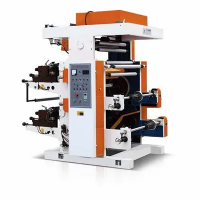
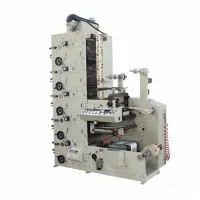
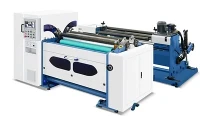
Slitting and Rewinding Machine
What is Slitting and Rewinding Machine
The paper slitting machine needs to perform fixed length slitting processing on the entire roll or sheet of raw materials, such as plastic packaging materials, packaging cartons, steel plates, films, leather, wood chips, etc., all of which require fixed length slitting control.The paper slitting machine has two types of slitting control: static and dynamic slitting: accurately stop the machine when the set length is reached, then perform static slitting processing, and restart operation after slitting; When the set length is reached, a cutting signal is sent out without stopping the machine, and the cutting machine dynamically cuts and processes the material during its movement.

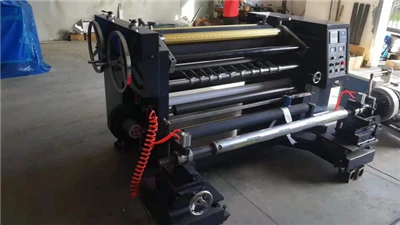
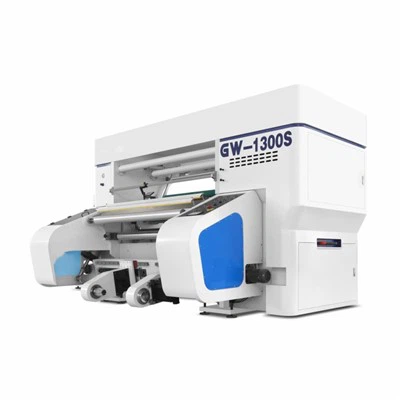

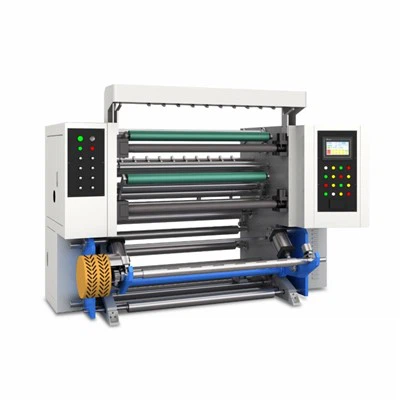


Advantages of Slitting and Rewinding Machine
Precision Cutting with PLC System
The core of our machine exists in the PLC system that thoroughly monitors the cutting length. It will be monitored through autocounter and alarm functions, which will stop the cutting process, thus ensuring that every cut is precise and consistent.
Effortless Material Loading with Auto Unwinder
You no longer need to spend plenty of time looking for materials to load onto the system. The cutting machine is equipped with an auto-load system whereby, upon reaching the required cut length, the cutting line automatically starts moving to the next roll. the web guiding system provides the feed and run of the tape correctly into the device without any break in the production process.
Stable Operation at High Speeds with Servo Motor
Speed is not an enemy of our machine since its reliability is incomparable. The servo-controlled motor is utilized for the rewinding part of the operation.
As a result, it runs smoothly, even at high speeds. The thing that makes this machine so trustworthy is its capacity to output the same quality product, regardless if it is running at an easy speed or pulling overtime to meet tight deadlines.
Versatile Slitting Options with Trim Reject Fan
One of our slitting machine's main features is its slitting configurations, which can be either a blade or a circular knife option. As a result, you can select the cutting method that will be best for you. the trim rejects the fan of the slit edge of the web. Hence, any errors are immediately drifted, leaving everything neat and accurate each time.
Labor-Saving Design with Hydraulic Auto Unloading
Machine offers an ergonomic design with its automatic unloading system on the rewinder. This ingenious mechanism saves time by speeding up the unloading process while lessening the demand for muscle power.
Why Choose US
Our Factory
Established 1999,name wenzhou jinghua machinery co.,ltd.exported machine to pakistan in 2007, exported machine to bangladesh 2008, exported machine to egypt 2009. and many other 50 coutries in these years.
Our Product
Dry laminating machine and other common machine. One is for customerized machine, such as foil printing machine, foil slitting machine, wax coating machine,PVC wall paper machine and so on.
QUALITY ASSURANCE
Two work-shop. One is for gravure printing machine, slitting machine,dry laminating machine and other common machine.
Our Service
We sincerely welcome friends from all over the world to cooperate with us on the basis of long-term mutual benefits.
How Automatic Slitting Machines Get the Job Done
These machines are lords of the craft, slicing large paper sheets into different thicknesses for various purposes such as printing, production of handles and ropes, and packaging. they have strong cutting blades but also can work fast due to a vast roll of paper. On top of that, they are adapted for simplicity of use and have a special system for monitoring and control. Here's How It Works:
Load up the web
To kick things off, load the big roll of the web onto the slitting machine. Depending on the end product, this web can vary in materials like paper, foil, or adhesive paper.
Set the width
Next, set the machine to cut the web into the specific widths required for your project. It's like giving the machine instructions on how wide each piece of paper needs to be.
Time to cut
Once everything's set, the machine swings into action. It begins slicing the web lengthwise into those desired widths you've programmed. It's akin to slicing a loaf of bread into different-sized pieces.
Keep it smooth
While the machine works magic, it ensures the web remains taut using a unique control system. This prevents any wrinkles or tears from forming as the cutting happens.
Customize as needed
One of the perks of these machines is their flexibility. You can tweak them to cut the paper into various widths, catering to different requirements. So, this machine has got you covered, whether it's making different-sized paper bags or handles.
Check for quality
Operators keep a close watch as the machine operates to ensure everything runs smoothly. If any issues arise, they quickly address them, providing the paper rolls turn out just right.
Ready to Roll
Once the cutting is complete, the machine spits out the finished paper rolls. Now, they're all set to be utilized for printing, creating handles, ropes, or any other purpose they're needed for.
What Is the Process of Using a Slitting Machine
Propulsion, film insertion and foil connection
Loading: According to the specifications of the cutting plan, according to the operating instructions of the crane and according to the actual situation, raise the corresponding mastercoil on the ageing frame, on the winding frame of the slitting machine, apply the steel core with the control button in accordance with the direction chosen from inside and outside of the crown surface and leave the steel bearing arm and running crane.
Film insertion: If there is no film on the slitting machine, the film must be drawn in. Bind the end of the original film to the ring eye of the film wool chain with the film insert device and the function button of the slitting machine and start the film insert button to distribute the film evenly along the cutting direction on each roll.
Film recording: If film is on the slitting machine and the connection is changed, use the vacuum film recording table to bring the film recording table into working position, manually smooth the film on the first reel of the slitting machine and start the upper vacuum pump to absorb the film, In order for the film to be absorbed smoothly on the film recording table, glue the double-sided tape and cut off the excess film under the tape, smooth the film on the drainage frame and start the lower vacuum pump to adsorb the film smoothly. Remove the paper layer on the tape and smooth the adhesive layer. The joint must be clean and free of wrinkles. Then switch off the upper and lower vacuum pumps and open the film recording table to the non-working position.
What Are the Basic Requirements for Using a Slitting Machine
The operating environment requirements for the slitting machine: The machine should be installed in a place with appropriate temperature, dryness, ventilation, good lighting, and convenient operation. In addition, in daily use, the usage environment should be kept clean, and the machine should be cleaned regularly to keep it clean.
Secondly, the operating requirements for using a slitting machine are to use high-quality longitudinal and transverse cutting knives; The machine needs to cut and process the entire roll or sheet of raw materials into fixed lengths; The fixed length slitting control of machines needs to be divided into two types: Static and dynamic slitting; The important performance indicators of machine fixed length slitting are slitting accuracy and good consistency of finished product length; The cutting length of the machine can be continuously set. If there is an error in the actual cutting length, it needs to be calibrated by setting parameters.
Precautions when using a slitting machine: Ensure that the voltage, current, and hydraulic equivalents are correct and stable before starting the machine; Before the machine is ready for operation, all personnel must be notified to leave to ensure personal safety before starting up and running; When the machine is running, do not touch the running film roll or roller core with your hands to avoid getting your hands rolled up and causing personal injury; During operation, do not use knives or hard objects to scratch or cut the various roller cores of the machine.
Main Parts of Slitter Machine

Following are the main machine parts and their functions.
Rotary Blade: Rotary blade is used for cutting the fabric through break Wales line.
Ring: Ring is use to help the cutting process.
Guide Roller: After slitting, plaiting of the fabric is done. Guide roller guides the fabric to plaiting.
Plaiting: Open fabric is make plait by plaiting.
Sensor: Sensor is used for identify the specific Wales line. It makes sense for cutting through break Wales's line.
Squeeze roller: To remove water.
Stretcher: To control width.
Over feeding wheels: To control GSM.
De-twisting device: To delivery the fabric roll in untwisted form.
Folding device: To delivery the fabric in folded form.
Other parts of slitting machine:
J box or Rope squeezing box
Turning table
Magnet (Glass)
Basket
Twister (used to untwist)
Centering roller
Delivery roller
Spinder roller
Folding roller
Padder for softener


Checking Parameters of Slitter:
• Cutting Line Check: Fabric cutting line is checked by the operator of the slitting machine. Operator checks that the rotary blade cut fabric through break Wales’s line or not.
• Bow and Slant check: Bow and slant is checked in the delivery side of the machine by the operator.
• Fabric Faults: Various fabric faults also checked in slitting process.
How to Improve the Efficiency of the Slitting and Rewinding Machine
Frequency converter drives the main dragging motor, providing motion and power for the transmission mechanisms.
The touch screen serves as the human-machine interface, accepting operator's instructions, setting and displaying various operating parameters.
Unwinding tension control system adopts constant tension unwinding to ensure that the raw materials will not deform or wrinkle during the slitting process.
Rewinding tension control system adopts constant torque rewinding, making the wound products loose or tight appropriately and having a neat end face.
The correction control system corrects the deviation caused by various factors during the raw material or transmission process, keeping the slitting edge always in the center of metalized film isolation zone.
The Slitting and Rewinding Machine is a mechanical equipment that slits wide paper, mica tape, or film into multiple narrow materials. We can lubricate the machine according to the following methods:
The method for lubricating the paper slitter rewinder machine is as follows:
The internal gears in the gear package have been lubricated with grease when the machine left factory, and need to be lubricated every six months.
When the transmission chains and gears are lack of oil, yellow grease should be added immediately.
Regularly check the lubrication of the reducer of the Slitting and Rewinding Machine. When the reducer is lack of oil, gear oil should be added immediately.
Do not use chemicals with corrosive properties to wipe the embossing wheel, rubber wheel, and take-up shaft.
Regularly check the brake pads of the unwinding shaft and the waste material shaft. When the brake pads are excessively worn, they should be updated immediately.
Check the gas source processor regularly every month to see if there are any abnormalities. When it is lack of oil, use non-corrosive lubricating oil to lubricate it.
Regularly check the lubrication of the bushing and shaft on the take-up shaft. Use non-corrosive lubricating oil for lubrication.

How to Choose Slitting Machine
Determine the model of the slitting and rewinding machine. There are many types of Slitting and rewinding machine equipment, with different models, different production capacities and different prices. It is necessary to determine where the slitting and rewinding machine is used, and then choose the model of the slitting and rewinding machine, and choose the one that suits you. slitting and rewinding machine.
Know the price of the equipment. Because the equipment produced by each manufacturer Is different and the price is different, the current slitting and rewinding machine equipment is basically a fully automatic slitting and rewinding machine. If you want to buy a slitting and rewinding machine, look at its automation. This greatly reduces the labor intensity and improves efficiency.
Understand the production speed. Only by knowing the maximum and minimum linear Speed of the slitter rewinder equipment can you find the right size unwinding, rewinding drive and pull-rolling drive.
Understand embossing and punching. Whether the embossing of the finished product Produced by the slitting and rewinding machine equipment is clear, and whether the perforation is clear and tidy, these are also indicators to judge the quality of the slitting and rewinding machine equipment, and will directly affect the sales.
What Affect Slitting Effect for Slitter Rewinder
Slitter rewinder machine is a machine to convert mother material rolls to narrower ones. Slitting effect of slitter rewinder is affected by many factors.
Unwinding tension control
Try to avoid changing the rewinding tension to ensure that the tightness of the material is uniform on the outside and inside. If the rewinding tension control of paper web is too small, the materials roll will loosen or slip on the bottom roller, forming wrinkles, interlacing of paper sheets and other problems. If the tension control is too large, it will cause damage to the paper core. Therefore, it is very necessary to control the tension during the rewinding operation of the adhesive paper web.
The linear pressure of the platen roller
As the diameter of the roll increases, the position of the pressing roller gradually rises, and the load provided by the pressing roller also gradually decreases. When the roll diameter reaches a certain value, the load provided by the platen roller is zero. At the moment, it only exists as a device to maintain the position of the paper roll. The pressure control program of the platen roller must be selected according to the paper quality and final diameter.
Speed difference between front and rear support rollers
The speed difference of the support roller forms the rewinding force, which determines the tightness of the paper roll. Increasing the rewinding force of the slitter rewinder can increase the tightness of the paper roll.
Before use, the main components of the fully automatic slitting machine should be inspected and lubricated; When inspecting and disassembling the fully automatic slitting machine, it is strictly prohibited to use inappropriate tools or adopt unscientific operating methods; Thoroughly clean and inspect the machine every two weeks; If the fully automatic slitting machine is stopped for a long time without use, all bright surfaces must be wiped clean, coated with rust proof oil, and covered with a plastic cover to cover the entire machine. If the fully automatic slitting machine is out of use for more than 3 months, moisture-proof paper should be coated on the anti rust oil; After completing the work, clean the equipment carefully, wipe the exposed friction surface clean, and add lubricating oil. Daily maintenance and upkeep
To do a good job in the daily maintenance and upkeep of the slitting machine, the following five points should be done well.
Firstly, regular cleaning and inspection of electrical components should be carried out to promptly eliminate potential hazards.
Secondly, the use of slitting machines relies on longitudinal and transverse cutting machines, so high-quality longitudinal and transverse cutting knives should be used.
Thirdly, the daily maintenance of the slitting machine should be in place, with the criteria being smooth, clean, and thoroughly cleaned (free of dust and debris) to ensure that the sliding parts of the equipment are in good condition.
Fourthly, it is maintenance work, and regular and irregular inspections of rotating parts should be stopped (especially real-time monitoring of vulnerable parts). Implement regular adjustments, replacements, and detailed records of the commutator to achieve the goal of extending the service life of the equipment.
Fifthly, improve the technical quality and level of personnel operating the slitting machine. For controlling local operations, a dedicated person should be responsible, and no one is allowed to operate without permission.
FAQ