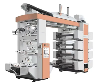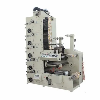
Gravure printing machines, as a precision equipment in the printing industry, occupies an important position in packaging, publishing, security and so on with its unique printing principle and high precision printing effect. It is one of the core goals of gravure printing machine technology development Achieving the precision of micro-printing. In this paper, the error control technology of gravure printing machines is analyzed from the aspects of engraving technique, registration control, tension control, mechanical precision control and environment control.
I. Laser engraving techniques: cornerstones of microfabrication
One of the core components of a gravure printing machine is the engraving roller, which has tiny cells carved into its surface, which determines the accuracy of the print. Traditional engraving techniques such as chemical etching and mechanical etching are difficult to meet micron printing accuracy due to low accuracy, long plate preparation cycle and environmental pollution. The advent of laser engraving technology revolutionized the gravure printing press.
Laser engraving uses high-energy laser beams to precisely burn tiny cells on the surface of cylinders. Features include:
High Precision: Laser engraving reduces line precision to 0.01 mm, satisfying the need of ultra-fine text, QR code, etc.
High efficiency: Laser engraving speed, a short time to complete large cylindrical engraving, to improve production efficiency.
Flexibility: Laser engraving can adjust the shape, size and depth of cells flexibly for personalized printing.
Environmental protection: Laser engraving eliminates the need for chemical etchings and reduces environmental pollution.
In laser engraving, the process of ``single shot, single cell"makes each laser pulse form a complete single cell, which realizes extremely high engraving efficiency and precision. In addition, 3D modulation technology allows independent control of the shape, diameter and depth of each cell, further improving printing quality.
ii. Overprint control technology: ensure that the precise overprinting in multicolor printing, gravure printing presses needs to ensure precise overprinting of each color pattern, i.e., overprinting accuracy. Errors in registration are one of the key factors affecting the quality of printing. In order to achieve the registration accuracy of micron scale, gravure printing presses adopts advanced registration control technology.
**Photoelectric Scanning System:** This system uses a photoelectric scanning head to monitor registration marks on printed materials in real time, converting changes in mark displacement into electrical signals, which are transmitted to the registration control system.
**Automatic color matching control system:** Accurate color matching, both both the longitudinal and transverse directions, is achieved by automatically adjusting the position or tension of each color printing unit based on signals from the photoelectric scanning system. For example, longitudinal registration errors are adjusted by changing the length of paper belt path between color units or the circumferential rotation angle printing cylinder; transverse registration errors are adjusted by adjusting the axial position of the printing cylinder or by using a transverse correction device.
**High-Precision Servo Motor:** drive compensation adjustment drum or printing drum, achieve micron precision movement, ensure registration accuracy.
**III. Tension Control Technology:** Maintain Stable Substrate Transfer** In gravure printing, substrate (such as paper or plastic film) needs to be transferred between multiple guide and pressure rollers. Tension fluctuations directly influences the registration accuracy and design quality of printing materials. In order to achieve "micron scale" printing accuracy, gravure printing presses adopts advanced tension control technology.
Automatic Tension Control System: utilizing devices such as magnetic powder brakes, torque motors or frequency converters, the tension of the substrate is monitored and adjusted in real time to ensure that the tension of the substrate remains constant throughout the printing process.
Multi-level Tension Control: set up Tension detection points in key parts such as release, feeding, release and rewinding to achieve multi-stage tension control and further improve tension stability.
Tension Compensation Algorithm: according to the substrate material, thickness, speed and other parameters, automatically adjust the tension control strategy to ensure accurate tension control under various printing conditions.
IV. INTRODUCTION Mechanical precision: Ensure equipment stability.
The mechanical precision of a gravure printing press is the basic factor that affects the printing quality. In order to achieve micron printing precision, gravure printing presses has a high requirement for mechanical precision in design and manufacture.
High precision guide rail and Bearings: adopt highprecision straight guide rail and ball screws, reduce movement error, ensure smooth transportation of roll material and accurate plate movement.
High Hardness Chassis: The chassis is manufactured of high strength material to ensure stability and reduce vibration and deformation when operating at high speed.
Precision Machining and Assembly: Precision precision machining assembly of key components such as printing plate cylinder and impression roller to ensure the compatibility and stability of each component.
V. Environmental Control: reducing the impact of external factors on the quality of printing.
Temperature, humidity, dust and other environmental factors will also affect the quality of gravure printing presses. In order to achieve micron printing accuracy, gravure printing presses needs to operate in constant temperature and humidity and take effective dust control measures.
Constant temperature and Constant Temperature and Humidity System: using air conditioners, humidifier and other equipment to control the temperature and humidity in the printing workshop in a suitable range, reducing material deformation and tension fluctuations caused by environmental change.
Dust control measures: use of Enclosed printing units and high efficiency air filtration system to reduce dust and impurities on printing materials and equipment.
Mar 15, 2026
Leave a message
How Does Gravure Printing Achieve Micron-Level Printing Precision? In-depth Analysis Of Error Control Techniques
Send Inquiry