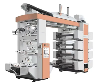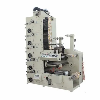
As the key equipment of printing industry, the gravure printing press plays an important role in packaging, publishing and security with its unique printing printing principle and high quality printing effect. Its core structure, from engraver drum to precision ink supply system, reflects the complex process design and technological innovation of all aspects. This paper will explore the core structure of gravure printing press and reveal the technical secrets of the gravure printing press.
I. Engraving Cylinder: the cornerstone of image transmission
One of the core components of a gravure printing press is the engraved cylinder, which is the cornerstone of image transmission. The engraving drum is usually composed of steel substrate, copper layer and a chromium layer, each with a specific function.
Steel Substrate: steel substrate acts as the support structure for the cylinder, providing the mechanical strength and stability necessary to ensure that the cylinder remains stable during high-speed rotation.
Copper layer: Plated on the surface of steel substrate, it has good ductility and processability, and is ideal for carving cells. Techniques such as chemical etching or laser engraving are used to create precise battery patterns on copper surface. These batteries can hold the ink required for printing.
Chromium layer: Chromium layer as a protective layer increases the hardness and abrasion resistance of the cylinder surface and extends the cylinder's lifespan. At the same time, chrome coating can prevent ink corrosion of copper layer and ensure the stability of printing quality.
Carving machine cylinder manufacturing technology has been developed from traditional etching technology to modern laser engraving technology. Traditional etching process has low cost, but low precision, long production cycle and serious environmental pollution. Laser engraving with its high precision, speed, environmental protection and other features have gradually become mainstream. Laser engraving system uses computer-controlled laser beam energy and scanning path to carve cells directly on the surface of cylindrical body to achieve precise control of cell shape and position.
ii. Doctor Blade System: Guardians of Ink Transfer
doctor blade system is another important component of gravure printing presses. It is responsible for scraping ink away from non-image areas on the surface of the cylinder, ensuring that only the ink inside the battery is retained for printing.
Doctor's blade: Usually made of stainless steel and other high-hardness metals, finely sharpened blades have a high sharpness and straightness. doctor's blade was precise. The angle, pressure and contact state of the blade with the cylinder surface directly affect the doctoring effect.
Knife frame and pressure plate: used to secure doctor blade and adjust its position and angle relative to cylinder surface. Precise adjustment the blade holder and pressure plate to ensure that the Doctor's blade uniform indentations on the cylinder surface, preventing incomplete ink removal or scratchings on the cylinder surface.
The working principle of the doctor blade system is relatively simple, but it requires a high level of technology to achieve an efficient and uniform doctor blade system. In actual production, according to printing materials, ink ink type, printing speed and other factors, adjust doctor blade pressure, angle, contact with cylinder.
III. Ink Supply System: Accurate control of ink transfer system In gravure printing presses, ink supply system is responsible for ink transfer to cylinder surface. It can precisely control the flow and distribution of ink to ensure that the cylinder surface is filled with the right amount of ink, thus achieving high quality printing results.
Ink tank: used for holding ink, usually open or closed design. The open ink tank dips the cylinder directly into ink, carries the ink out through the cylinder's rotation, and secures the cartridge to the cartridge. Closed ink tank using inkjet or ink delivery rollers transfer ink to the surface of the drum, reducing solvent evaporation and ink waste.
Ink pump and piping: responsible for ink transfer from ink tank to cylinder surface. Ink pump generally adopts pneumatic diaphragm pumps or gear pumps, stable flow rate, corrosion resistance. Pipeline design focuses on minimizing ink residue and air bubble formation to ensure continuous and uniform ink delivery.
Ink Circulation System: In order to maintain ink flow and stability, gravure printing presses will generally be equipped with an ink circulation system. The system in ink tank and ink ink supply between the use of circulatory pump to prevent ink sedimentation and solidification, while adjusting the temperature and viscosity of ink, to ensure the consistency of printing quality.
IV. INTRODUCTION INTRODUCTION Impression Cylinder and Tension Control System: Precise Adjustment of Printing Pressure
Imprint roller and tension control system are key components of gravure printing presses to ensure the stability of printing pressure and constant material tension.
Impression Cylinder: used in conjunction with engraving roller to transfer ink from cylinder to substrate surface applying appropriate pressure. The surface of an imprint roller is usually coated with a layer of rubber to increase contact area and friction with the substrate to ensure adequate ink transfer. At the same time, according to the printing materials and printing requirements, accurately choose the diameter and hardness of impression cylinder.
Tension control system: During printing, the substrate needs to be transferred and stretched between rollers. The tension control system monitors and adjusts the tension of the substrate to ensure that the tension in the printing process remains the same and to avoid problems of printing quality caused by the variation in tension. Tension control usually adopts torque motors, magnetic powder brakes or frequency converters, which has good tension stability and rapid response ability.
V. Drying System: Efficient Guarantee for Ink Curing
The drying system is the key component of gravure printing presses, which ensures rapid curing of ink. Because gravure printing inks is usually highly volatile, so the drying system to quickly remove solvents in the ink, so that it forms a solid film on the substrate.
Hot air cycle Drying System: This system produces hot air through electric heating or steam heating, which circulates hot air on the surface of the substrate and accelerates the evaporation and curing of ink solvent. Thermal air circulation drying systems with high drying efficiency efficiency and accurate temperature control is suitable for all kinds of gravure printing presses.
Infrared or Far Infrared Drying System: The system utilizes infrared or Far Infrared radiation to directly heat ink on the substrate surface, allowing ink to solidify quickly. Infrared drying systems has the advantages of drying speed and low energy consumption, especially suitable for printing applications which require high drying speeds.
Mar 01, 2026
Leave a message
Gravure Printing Press Core Structure Analysis: Technical Secrets From Engraving Cylinders To Precision Ink Supply
Send Inquiry