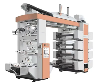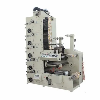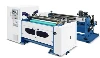
In the future, The gravure printing industry will develop around six core directions: green, intelligent, high speed, high accuracy, individualization, service and internationalization. The specific analysis is as follows:
1.Eco-friendly: Eco-powered Technological Upgrades
* ** Promotion of Low-VOC Inks:** The application rate of water-based inks, UV inks and other environmentally friendly materials will continue to improve. For example, China water-based ink gravure printing machines market share reached 37% in 2025 and is expected to surpass 50% by 2027. UV inks penetration rate in the pharmaceutical packaging field is increasing rapidly due to characteristics such as fast curing and low mobility.
* **Breakthroughs in Exhaust Treatment:** Regenerative Thermal Oxidizer (RTO) technology can achieve a VOCs removal rate over 99% while recovering and drying heat, saving 40% -50%; closed-loop cleaning systems can reduce VOCs emissions to one-third of national standards.
* **Policy-Driven Transition:** Stricter global environmental regulations,such as the EU's REACH regulation increase restrictions on SVHC substances, are driving companies to accelerate their green transition. China's "14th Five-Year Plan for the Development of the Printing Industry explicitly calls for a 30% reduction in total emissions of volatile organic compounds (VOCs) throughout the industry by 2020. The number of green print certifiers has increased from 326 in 2020 to 1,247 by 2025.
2.Intelligent: Digital Technology Reshapes Production Models
Automation Control Upgrades: Electronic drive technology replaces mechanical drive shafts, improves printing speed to 400m/min and reduces pre-registration time by 50%; AI algorithms dynamically adjust "temperature speed" parameters to control registration accuracy to ±0.1mm.
Remote Operation and Fault Prediction: IoT sensors collect equipment operation data in real time, combine with improved stochastic forest model to achieve fault warnings with a diagnostic accuracy of more than 95%; MES systems integrate the entire production process, increasing equipment utilization by 25% and on-time delivery from 85% to 98%.
Digital Twin Application: Analog printing process in virtual environment can optimize parameter configuration and reduce trial and error cost. One company, for example, has shortened the development cycle of new products by 30% through digital twinning.
3. High Speed and High Precision: Double Improvement of Efficiency and Quality
Speed breaks through unscathed: Mainstream wide-format gravure printing presses maintain speeds of more than 300m/min, with some models reaching 450m/min, more than double what they were a decade ago. servo motors and high-precision transmission reduce vibration, ensuring stability in high-speed printing.
Precision Optimization: Laser engraving plate technology controls dot diameter to less than 10 micrometers, nanoceramic printing roller surface hardness to HV2000+, printing durability from 500,000 to 3.5 million revolutions, friction coefficient reduced to 0.05-0.1, and ink transfer rate increased by 12%.
Ultra-Precision Machining: 5-axis processing centers achieve roller surface roughness ≤ 0.05 micron, ensuring dot uniformity; 3D printing technology rapidly manufactures complex ink path structures, shortening the development cycle of new products.
4. Personalization and flexibility: Adapt to Small-Batch and Multi-Variety Needs
Modular Design: Supports rapid plate changes and process switching. The label and e-cigarette packaging industry is in high demand for narrow-web gravure printing machines (less than 800mm wide) with a 12% year-over-year market share growth in 2024.
Hybrid Printing Technology: adopt ``long-term gravure + short-term digital printing '', combine gravure and digital printing, realize flexible production. In cigarette packaging printing, for example, gravure printing complete large backdrops, while digital prints cover variable QR codes, balancing efficiency and personalization.
Special process expansion: UV cold foil stamping, micro-nano texture and other technologies to improve the added value of packaging. An international brand of skin care products packaging with eight-color gravure printing + UV curing, stereoscopic visual effects, driving high-end equipment import substitution.
V. Serving and ecologizing: from device sales to Full Lifecycle Services
Business model transformation: enterprises from equipment suppliers to ``manufacturing + services' 'integrated solution providers to provide remote transport dimension, process optimization, carbon footprint accounting and other value-added services. For example, 45.3% of new high-end devices sold have capabilities such as MES integration, AI process optimization, and remote transport dimensions.
Supply chain Collaboration: leading enterprises through merger and acquisition integration, to form a set of design, plate making, printing, testing in one service capability. The CR5 market concentration is projected to increase from 28% in 2025 to 38% in 2030.
Cross-Industry Ecosystem Integration: Leveraging the evolutionary experience of the packaging machinery and digital printing ecosystems, the company is exploring emerging models such as subscription-based and on-demand printing, strengthening joint research with ink and substrate suppliers, and promoting collaborative innovation in materials, processes, and equipment.
6. Internationalization: expansion into emerging markets and global value chains
Export potential unleashed: Chinese gravure printing machines is rapidly increasing penetration rate in emerging markets such as Southeast Asia and the Middle East due to its value for money advantages. Exports in 2024 were $960 million, up 12.3% from a year earlier, mainly to countries such as India and Vietnam. The share of exports is projected to rise from 12% to more than 20% by 2030.
High-end market breakthroughs: High-end models such as the domestically produced FSG-1650E have been certified as China Tobacco products, leading to export breakthroughs that gradually break the monopoly of foreign brands in the ultra-large high-end model market (foreign brands will still hold 62.3% of the market in 2025).
Alignment with international standards: As RCEP deepens, Chinese gravure printing companies need to strengthen international certification (e.g. FDA and REACH) to improve their competitiveness in the global market.
Feb 15, 2026
Leave a message
What Directions Will The Gravure Printing Industry Take in The Future?
Send Inquiry