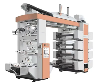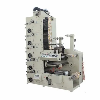
The working principle of flexographic printing machines mainly involves the collaboration of multiple components, including printing plates, ink pumps, ink cartridges, printing heads, substrate conveying devices, and ink control devices.
A flexographic printing machine uses letterpress printing technology, where the printing plate is made of flexible materials and includes a graphic and textual part. The ink is transmitted through the mesh roller and evenly coated on the graphic and textual parts of the printing plate. The ink scraper is used to remove excess ink from the mesh roller, ensuring that the ink is evenly applied to the surface of the printing plate. When pressure is applied between the printing plate and the embossing drum, the ink on the printing plate is transferred to the substrate (such as paper, plastic sheets, etc.), forming clear graphics and text. This process also includes an ink control device to ensure uniform distribution of ink on the printing plate, as well as a substrate transfer device for feeding the substrate material into the printing section and collecting the printed material. Finally, the printed material is dried to complete the printing process.