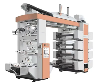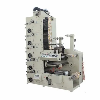
ELS-driven gravure printing presses achieves high precision color matching (±0.08mm) through an electronic shaft drive systems high-precision servo motors, photoelectric sensors and encoders, and central controller computation and correction devices. The longitudinal and transverse color registration systems vary greatly in detection methods, control objects and actuators, as follows:
I. Core Principles of High Accuracy Color Matching for ELS Drives
* **Electronic Shaft Drive System:** The electronic drive system uses independent motor to drive the printing printing plate cylinders of each printing unit directly, eliminating mechanical transmission errors. For example, a B&R ACOPOS servo controller and a high-precision servo motor for the Shaanxi Beiren PRD360ELS model ensure synchronized accuracy of printing roller ± 0.01mm, laying the foundation for color matching.
* Photoelectric Sensor and Encoder Detection:**
:: Longitudinal Color Registration: Photoelectric sensors can detect color marks arranged vertically on the substrate (e.g., A-type color marks, spaced 20mm apart). If the color mark spacing becomes 19.9mm or 20.1mm due to printing deviations, the system determines the color registration error to be ±0.1mm (which can actually be optimized to ±0.08mm).
* Lateral Color Registration: A photoelectric sensor detects color marks arranged on the side (e.g., category B colour markings, 2.5 mm center line width). If deviation causes a change in the width of the line, the system determines the transverse error by geometric calculation.
Central Controller Calculation: The central controller (e.g., computer host + I/O port) receives pulse signals from the photoelectric sensor and encoders and analyses the direction and size of registration deviation. For example, if the pulse of the second color is delayed by a time T relative to the first color, the system produces a rectangular pulse of T width as a correction signal.
Correction Device Execution: Longitudinal Correction: precision ball screw driven by stepper motor adjusts position of guide rollers to compensate for feed length error.
Transverse Correction: Adjust the The axial position of the printing cylinder (e.g. through differential gearbox) or adjust the drum using transverse registration.
Closed-Loop Feedback and dynamic correction: This system corrects the registration deviation of the printing cylinder every time it rotates, eliminating error accumulation. For example, the FR400ELS model maintains longitudinal and transverse color registration accuracy ≤±0.1mm even at 400 m/min high-speed and can be optimized to ±0.08mm in practice.
ii. Vertical and Horizontal Color Registration Systems
Comparison Dimensions: Vertical Color System | Horizontal Color System
Detection Object: Vertically arranged color marks (e.g., Type A color marks, spaced 20mm apart), detect error in feed length. Horizontal color marks (e.g., Type B color marks, centerline width 2.5mm) to detect lateral misalignment error.
Control object: Adjust the position of the guide roller or the circumferential angle of the printing cylinder to compensate for vertical registration deviation. Adjust the axial position printing cylinder or use the side registration adjustment drum to compensate for the side registration deviation.
Actuation Mechanism: Stepper motor drive ball screw, vertical lifting guide roller. Stepper motor drives differential gearbox or transversely adjustment roller to adjust cylinder the axial position.
Typical Typical Application Scenarios: Vertical color mismatch due to linear velocity and tension fluctuations in high-speed printing. Lateral misalignment due to mechanical errors, uneven material thickness or tension fluctuations.
Accuracy Requirements: Requires ±0.08mm (e.g., FR400ELS model) and relies on high-precision encoders and servo motors. Accuracy also needs to be ±0.08mm, but the effect of lateral expansion and contraction of the material on accuracy must additionally be considered.
III. Technical Advantages and examples
Advantages: The ELS transmission increases the color accuracy of conventional mechanical axles from ± 0.15mm to ±0.08mm through electronic transmission and closed-loop control, while reducing waste rates by more than 40%.
Jan 15, 2026
Leave a message
How Does The ELS Drive Achieve High-precision Color Matching (±0.08mm)? What Are The Differences Between The Longitudinal And Transverse Color Matching Systems?
Send Inquiry